Introduction
The standard validation ritual of systematic trading is walk-forward optimization (WFO): optimize the strategy’s parameters on an in-sample (IS) window, evaluate the selected configuration on the immediately following out-of-sample (OOS) segment, roll the window forward, and stitch the OOS segments into a single pseudo-live track record [13, 14, 18]. Its acceptance statistic is the walk-forward efficiency of [14]: the ratio of OOS to IS performance, near one when the optimization captured persistent structure and near zero when it curve-fit noise. The statistic is embedded in commercial tooling—TradeStation’s Walk-Forward Optimizer fails any strategy whose walk-forward efficiency falls below 50\% [19]—and around it has grown an informal grading folklore: ratios above {\sim}0.8 signal robustness, 0.5 marks the pass/fail boundary, and values below {\sim}0.3 indicate overfitting. In circulating recipes the ratio is often computed literally as summed OOS PnL over summed IS PnL, and read both in aggregate and window by window.1
None of this folklore has, to our knowledge, been measured where the truth is known. Does the walk-forward efficiency ratio (WFER) actually predict forward performance—and better than what alternative? Do the thresholds correspond to calibrated decision boundaries? Should the IS window be anchored (expanding) or rolling, and how finely should the history be partitioned into folds? The academic literature rigorously treats adjacent problems—backtest overfitting [2, 3], data snooping [20], splitting schemes for dependent data [5, 12]—but the WFE ratio itself, the statistic practitioners actually gate deployments on, has remained untested.
We provide that test in a controlled simulation. A one-parameter strategy family has a population annualized-Sharpe surface that we control exactly, including how its optimum moves through time: it can stay put (stationary), drift linearly, jump at a structural break, or not exist at all (a no-edge null). Because the surface is known, the true expected Sharpe of deploying any configuration over a future horizon is computable exactly, and every validation procedure—and every diagnostic it emits—can be judged against that ground truth. Our findings are deliberately mixed: the ratio is genuinely informative yet strictly dominated by simpler statistics computed from the very same folds; its thresholds fail in two distinct ways; and the window-design folklore is directionally right at an unstated price.
Contributions.
A reproducible framework in which walk-forward validation is run against a known, time-varying Sharpe surface under four regimes (stationary, drift, break, null), with five procedures evaluated on the same simulated histories and the forward truth of every deployment computed exactly: 8{,}000 main experiments evaluating all five procedures, plus a 9{,}000-run window-design sweep of the rolling procedure (Sections 4–5).
The first operating characteristics of the WFER. It carries signal (Spearman \rho=0.451 against true forward Sharpe; AUC 0.743 for detecting deployed losers) but is dominated, on every regime with an edge, by the stitched OOS t-statistic (AUC 0.781) and OOS Sharpe (\rho=0.529) computed from the same folds; and its per-window form is ill-conditioned in 21.4\% of runs (47.3\% under the null) (Sections 6.1 and 6.3).
A calibration of the folk thresholds. The \ge 0.8 bin is indistinguishable from 0.5–0.8 (mean forward Sharpe 0.980 vs. 0.994); the “borderline/overfit” zone below 0.5 contains configurations averaging +0.59 to +0.83; and the literal raw-PnL ratio cannot reach its own thresholds (6 of 8{,}000 runs at {\ge}0.5), because it compares accumulation windows of different lengths (Section 6.2).
A paired anchored-vs.-rolling comparison on identical OOS segments: anchored wins under stationarity (+0.100 forward Sharpe, p\approx2\times10^{-39}), rolling under drift (+0.079) and breaks (+0.154)—the folklore direction, with a stationarity cost the folklore does not state (Section 6.4).
A window-design sweep and a five-procedure ranking showing that window length shapes mainly the estimate (diagnostic–forward correlation peaks at 0.52 near nine folds, collapses to 0.23 at one fold), not the deployment (flat for train length {\ge}126); that rolling WFO deploys best (0.657) while naive shuffled k-fold is the most optimistic estimator (+0.083 bias, worse under drift and breaks); and that CPCV-lite’s estimate ranks outcomes best (\rho=0.636) (Sections 6.5–6.6).
Related work
Walk-forward optimization and the efficiency ratio.
Walk-forward analysis originates in the practitioner literature on trading-system development. [13] introduced the procedure of repeatedly optimizing a strategy’s parameters on an IS window and evaluating the selected configuration on the immediately following OOS segment, stitching the OOS segments into a single pseudo-live track record. The substantially revised second edition [14] systematized the methodology and proposed the walk-forward efficiency (WFE)—the ratio of annualized OOS performance to annualized IS performance—as the central diagnostic of whether an optimization captured persistent structure or merely curve-fit noise. Practitioner texts adopted the procedure essentially unchanged [18], and it is now embedded in retail and institutional tooling: TradeStation’s Walk-Forward Optimizer, for example, fails any strategy whose WFE falls below 50\% under its default test criteria [19]. Around this default has grown an informal grading folklore—ratios near 0.8 signal robustness, 0.5 marks the pass/fail boundary, and values below roughly 0.3 indicate overfitting—that circulates in platform documentation, trading courses, and blogs without any traceable empirical validation. To our knowledge, no published study has measured the operating characteristics of the WFE ratio (its sampling distribution, its correlation with true forward performance, or the error rates implied by these thresholds) in a setting where the ground truth is known. Nor has the practitioner literature resolved basic design questions it raises only heuristically: anchored versus rolling in-sample windows, and how finely the history should be partitioned into walk-forward folds.
Backtest overfitting and multiple testing.
A parallel academic literature has quantified how easily backtests mislead. [2] showed that the expected maximum Sharpe ratio over N random configurations grows without bound, so impressive IS results are nearly guaranteed given enough trials. [3] formalized the probability of backtest overfitting (PBO) via combinatorially symmetric cross-validation (CSCV), which evaluates whether configurations selected in-sample systematically underperform out-of-sample. [4] derived the deflated Sharpe ratio, which corrects observed performance for the number of trials and non-normality, and [9] proposed multiple-testing haircuts to reported Sharpe ratios; [1] distilled these concerns into a research protocol for the machine-learning era. This line of work descends from the data-snooping literature in econometrics: [20] introduced the Reality Check for testing whether the best of many models beats a benchmark after accounting for the search, and [8] sharpened it into the more powerful Superior Predictive Ability test. These tools diagnose selection bias given a backtesting protocol; they do not tell us whether walk-forward validation itself—the protocol practitioners actually use to combat overfitting—produces forward-performance estimates that can be trusted, nor how its diagnostic ratio behaves under regime change.
Cross-validation for dependent data.
A third strand asks how predictive accuracy should be estimated for time series at all. [17] reviewed out-of-sample evaluation designs—fixed versus rolling origins, window updating, single versus multiple test periods—and noted how sensitive conclusions are to these choices. [5] compared blocked and standard cross-validation against last-block evaluation for machine-learning predictors, finding cross-validation often yields more robust model selection; [6] proved that standard k-fold cross-validation remains valid for purely autoregressive models with uncorrelated errors. Conversely, [7] found empirically that out-of-sample (forward) procedures are more reliable than cross-validation when series are non-stationary. In finance, [12] argued that naive k-fold leaks information through overlapping and serially correlated labels, proposing purged k-fold and combinatorial purged cross-validation (CPCV) as alternatives that generate many backtest paths. This debate concerns splitting schemes and the bias of error estimates; the WFE ratio—a statistic computed on top of a splitting scheme and an optimization step—has remained outside its scope.
In-sample versus out-of-sample tests and window choice.
Econometricians have long questioned the primacy of OOS evidence. [11] showed that in-sample and out-of-sample predictability tests are equally reliable under the null, and that sample-splitting sacrifices power, so insisting on OOS confirmation is not a free lunch. [16] demonstrated that OOS conclusions can hinge on the arbitrary choice of estimation-window size and proposed tests robust to that choice, while [10] derived optimal rolling-window sizes when parameters drift—directly relevant to the anchored-versus-rolling question in walk-forward design. The survey of [15] documents pervasive model instability as a central fact of predictive finance. These results imply that walk-forward outcomes are functions of window design in ways practitioners rarely acknowledge, but the literature evaluates forecast accuracy tests, not parameter-selection pipelines with a WFE-style acceptance rule.
Positioning.
In sum, walk-forward optimization is the de facto standard validation protocol in systematic trading, and the walk-forward efficiency ratio is its de facto acceptance statistic—yet both live almost entirely in practitioner folklore. The academic literature offers rigorous tools for adjacent problems: detecting data snooping [8, 20], quantifying backtest overfitting [3, 4], and choosing splitting schemes for dependent data [5, 7, 12]. None of it validates the WFE ratio against a known ground truth, tests the 0.8/0.5/0.3 folk thresholds, or compares anchored and rolling walk-forward against purged cross-validation under controlled stationarity, drift, and structural breaks. This paper fills that gap with a simulation study in which the true, time-varying Sharpe surface is known by construction, so the predictive value of every diagnostic can be measured exactly.
The efficiency ratio and the validation procedures
Setting.
A strategy family is indexed by a parameter \theta on a grid in [0,1]. A validation procedure partitions a history of T_{\mathrm{hist}} periods into folds j=1,\dots,J, each with a train window W_j^{\mathrm{tr}} and a test window W_j^{\mathrm{te}}. Within each fold the selection rule is fixed throughout this paper: \hat\theta_j = \arg\max_\theta \widehat{\mathrm{SR}}(\theta; W_j^{\mathrm{tr}}), the argmax of the annualized train-window Sharpe. Let I_j and O_j be the summed PnL of \hat\theta_j over W_j^{\mathrm{tr}} and W_j^{\mathrm{te}}, and let N_{\mathrm{IS}}=\sum_j |W_j^{\mathrm{tr}}|, N_{\mathrm{OOS}}=\sum_j |W_j^{\mathrm{te}}|.
Two readings of the ratio.
The literal practitioner formula is the raw ratio of PnL sums, \begin{equation} \mathrm{WFER}_{\mathrm{raw}} \;=\; \frac{\sum_j O_j}{\sum_j I_j}, \label{eq:raw} \end{equation} while Pardo’s annualized-to-annualized definition corresponds to the per-period normalized form \begin{equation} \mathrm{WFER}_{\mathrm{norm}} \;=\; \frac{\sum_j O_j / N_{\mathrm{OOS}}}{\sum_j I_j / N_{\mathrm{IS}}} \;=\; \frac{N_{\mathrm{IS}}}{N_{\mathrm{OOS}}}\,\mathrm{WFER}_{\mathrm{raw}}. \label{eq:norm} \end{equation} The distinction is not cosmetic. In walk-forward practice the IS windows are several times longer than the OOS windows (three to four times in our designs), so (raw) divides PnL accumulated over very different amounts of time: even a perfectly persistent edge scores \mathrm{WFER}_{\mathrm{raw}} \approx N_{\mathrm{OOS}}/N_{\mathrm{IS}} \approx 0.25–0.33. The normalized form (norm) is the only reading under which the folk thresholds (\ge 0.8 “excellent,” 0.5–0.8 “acceptable,” 0.3–0.5 “borderline,” <0.3 “overfit,” <0 “unprofitable”) can even potentially be meaningful; Section 6.2 quantifies what happens when they are applied to either form. Both forms are undefined when \sum_j I_j \le 0 (the implicit assumption of the grading table is a positive IS denominator), and the per-window variant O_j/I_j is ill-conditioned whenever a single I_j is near zero (Section 6.3).
Five procedures.
We evaluate five ways of building the folds, all sharing the selection rule above (Figure 1, bottom):
Single split: one fold; the last 25–35\% of the history is held out. Deploys the argmax of the train portion.
Anchored WFO: expanding train window from the start of history; aligned OOS segments of length L_{\mathrm{test}} starting at L_{\mathrm{train}}. Deploys the argmax over the full history (its last expanding window, extended to the end).
Rolling WFO: train window of fixed length L_{\mathrm{train}} ending where each OOS segment begins; the step equals L_{\mathrm{test}}, so OOS segments tile the history without overlap and anchored/rolling share identical test segments—their comparison is paired on the same data. Deploys the argmax over the most recent L_{\mathrm{train}} periods.
Naive shuffled k-fold: the deliberately time-blind baseline; k=5 shuffled folds. Deploys the textbook CV selection: argmax of the mean per-fold test Sharpe.
CPCV-lite: a documented simplification of combinatorial purged cross-validation [12]: the history is cut into 6 contiguous groups, every \binom{6}{2}=15 choice of 2 test groups forms a fold, and an embargo of 10 periods is dropped from the train set at each test-group boundary. We call it “lite” deliberately: in our generative model returns are serially independent given the surface, so there are no overlapping labels to purge; the embargo mirrors the procedure as practiced rather than removing genuine leakage. (CPCV is distinct from the CSCV scheme of [3], which underlies PBO.) Deploys the argmax over the full history, per the final-fit convention.
Diagnostics.
From each procedure’s folds we record the two WFER variants (raw)–(norm) and five simpler statistics computed from the same raw material: the stitched OOS Sharpe (annualized Sharpe of the concatenated test-window returns of the per-fold selections), the OOS t-statistic (\bar r_{\mathrm{OOS}}/s_{\mathrm{OOS}}\cdot \sqrt{N_{\mathrm{OOS}}}), the mean per-fold IS\toOOS rank correlation (Spearman correlation across \theta between train-window and test-window Sharpe), the fold win rate (fraction of folds with O_j>0), and the \theta-instability (standard deviation of the selected \hat\theta_j across folds, in [0,1] units; the folklore reads unstable selections as a warning sign, so it enters orientation-flipped).
Simulation framework

A known, time-varying Sharpe surface.
Each experiment draws a population surface over the parameter grid, \begin{equation} \mathrm{SR}_{\mathrm{true}}(\theta,t) \;=\; \mathrm{clip}_{\pm 4}\!\left[\, b \;+\; A \exp\!\left(-\frac{(\theta - c(t))^2}{2 w^2}\right)\right], \label{eq:surface} \end{equation} a Gaussian bump of amplitude A and width w on a floor b, whose center c(t) moves according to the regime: stationary (c(t)=c_0 throughout), drift (c(t) moves linearly from c_0 to c_1 across history plus forward horizon), break (c(t)=c_0 until a sampled break time inside the history, then jumps to c_1), and null (A=0 with a non-positive floor: nothing to find). Per-period returns at each grid point carry a shared market factor, \begin{equation} r_t(\theta) \;=\; \frac{\mathrm{SR}_{\mathrm{true}}(\theta,t)}{\sqrt{P}} \;+\; \sqrt{\phi}\,F_t \;+\; \sqrt{1-\phi}\,\varepsilon_t(\theta), \qquad P = 252, \label{eq:returns} \end{equation} with F_t and \varepsilon_t(\theta) standard normal, so each column has unit per-period variance, the population annualized Sharpe at time t equals \mathrm{SR}_{\mathrm{true}}(\theta,t), and nearby strategies co-move with factor share \phi—the cross-sectional structure walk-forward folds actually face.
Ground truth.
Because the surface is known, the true expected annualized Sharpe of deploying any \theta over the forward horizon is the time-average \begin{equation} \mathrm{SR}_{\mathrm{fwd}}(\theta) \;=\; \frac{1}{T_{\mathrm{fwd}}} \sum_{t=T_{\mathrm{hist}}}^{T_{\mathrm{hist}}+T_{\mathrm{fwd}}-1} \mathrm{SR}_{\mathrm{true}}(\theta,t) \label{eq:fwd} \end{equation} (the O(\mathrm{SR}^2/P) variance contribution of a moving mean is negligible at these Sharpe levels). Every procedure is scored on \mathrm{SR}_{\mathrm{fwd}}(\hat\theta_{\mathrm{deploy}}) of the configuration it would put into production; a run deployed a loser if that value is negative, and its regret is the gap to the forward-optimal \max_\theta \mathrm{SR}_{\mathrm{fwd}}(\theta).
Sampled design.
Every constant that affects results is either disclosed here or recorded per experiment; there are no hidden constants. Each run independently draws: grid size n_\theta \in \{25, 31, 41\}; history length T_{\mathrm{hist}} \in \{504, 756, 1008\} with forward horizon T_{\mathrm{fwd}} = 252 fixed; amplitude A \sim U(0.4, 2.0) (zero for null); width w \sim U(0.10, 0.35); floor b \sim U(-0.2, 0.2) (null: b \sim U(-0.10, 0)); initial center c_0 \sim U(0.25, 0.75); for drift and break, a shift of magnitude U(0.2, 0.5) in a random direction with c_1 clipped to [0.05, 0.95]; break time U(0.3, 0.9) as a fraction of the history; factor share \phi \sim U(0.05, 0.5). Window design follows the practitioner rules of thumb the recipe itself prescribes: train length a sampled fraction \{0.2, 0.3, 0.4, 0.5\} of the history, test length 1/4 or 1/3 of train (minimum 21), step equal to the test length (so OOS segments never overlap, and consecutive rolling train windows overlap by 67–75\%); the single split holds out a fraction \{0.25, 0.30, 0.35\}; k-fold uses k=5; CPCV-lite uses 6 groups, 2 test groups, embargo 10.
Experimental setup
The main batch runs 8{,}000 experiments with regimes cycled for exactly 2{,}000 per regime, master seed 101 spawned into independent per-run generators. Within each run, all five procedures see the same simulated history, so every cross-procedure comparison is paired. The window-design sweep holds T_{\mathrm{hist}} = 756 fixed and forces the rolling train length across \{63, 126, 189, 252, 378, 504\} with test length \max(21, L_{\mathrm{train}}/3), 1{,}500 runs per cell (9{,}000 total; seed 303), tracing the fold count from 33 down to 1. Everything is deterministic given the two seeds; no number in this paper depends on wall-clock or unseeded state.
Results
WFER is informative—and dominated by simpler statistics from the same folds
| Spearman \rho vs. true forward Sharpe | |||||||
| Diagnostic | overall | station. | drift | break | null | ex-null | AUC |
| Normalized WFER | 0.451 | 0.387 | 0.365 | 0.260 | 0.022 | 0.338 | 0.743 |
| Raw WFER | 0.447 | 0.381 | 0.360 | 0.257 | 0.021 | 0.333 | 0.742 |
| Stitched OOS Sharpe | 0.529 | 0.469 | 0.435 | 0.320 | 0.017 | 0.408 | 0.779 |
| OOS t-statistic | 0.532 | 0.467 | 0.436 | 0.327 | 0.017 | 0.410 | 0.781 |
| IS\toOOS rank corr. | 0.516 | 0.508 | 0.442 | 0.318 | 0.036 | 0.424 | 0.752 |
| Fold win rate | 0.434 | 0.386 | 0.335 | 0.246 | -0.012 | 0.323 | 0.733 |
| \theta-instability (-) | 0.408 | 0.371 | 0.279 | 0.142 | -0.004 | 0.266 | 0.733 |
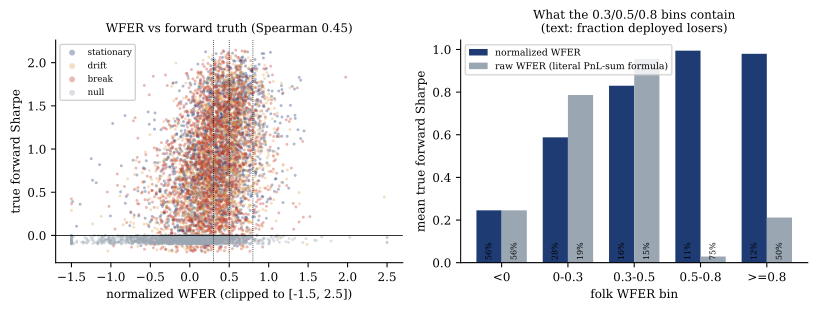
Table 1 and Figure 2 (left) give the headline operating characteristics. The normalized WFER is genuinely informative: Spearman \rho = 0.451 against the true forward Sharpe and AUC 0.743 for detecting a deployed loser. The folklore is not testing nothing.
But it is never the best statistic on offer. On every column of Table 1 except the noise-level null, both WFER variants are beaten by at least two of the simpler diagnostics computed from the same folds: the stitched OOS t-statistic (\rho = 0.532, AUC 0.781), the stitched OOS Sharpe (\rho = 0.529, AUC 0.779), and the IS\toOOS rank correlation (\rho = 0.516, and the best per-regime correlations under stationarity and drift). The mechanism is visible in (norm): the ratio’s numerator is essentially the stitched OOS mean, which carries the forward-relevant information; the denominator is the selection-inflated IS mean, which is noisy and nearly uninformative about the future, so dividing by it mostly injects noise. Consistent with this, the two WFER variants rank runs almost identically (\rho = 0.451 vs. 0.447): within a run the normalization (norm) is a constant factor, so ranking is barely affected—what the normalization changes is the location of the distribution relative to fixed thresholds, which is exactly where the raw form fails (Section 6.2).
Three qualifications sharpen the picture. First, quality degrades as the world becomes less stationary: WFER’s per-regime correlation falls from 0.387 (stationary) through 0.365 (drift) to 0.260 (break), and every other diagnostic degrades in the same order—validation statistics are most trustworthy exactly when they are least needed. Second, within the null regime every diagnostic is uninformative (|\rho| \le 0.036, within sampling noise of zero): once there is no edge, no fold statistic separates slightly-less-negative from slightly-more-negative deployments. A substantial part of the headline AUC therefore comes from separating null from non-null runs: excluding the null regime, WFER’s AUC drops from 0.743 to 0.685. Third, the ordering is not an artifact of the rolling procedure: on anchored folds the picture is the same (WFER \rho = 0.417 vs. OOS t-statistic 0.527; the IS\toOOS rank correlation is anchored’s best at 0.542).
The folk thresholds are miscalibrated, and the raw ratio cannot reach them
| Normalized WFER | Raw WFER (literal formula) | |||||||
| Bin | n | mean fwd SR | loser | null | n | mean fwd SR | loser | null |
| <0 | 1947 | 0.246 | 56.5% | 51.7% | 1947 | 0.246 | 56.5% | 51.7% |
| 0–0.3 | 2324 | 0.588 | 28.4% | 24.1% | 5887 | 0.786 | 19.3% | 16.4% |
| 0.3–0.5 | 1728 | 0.830 | 16.0% | 13.4% | 156 | 0.956 | 15.4% | 14.1% |
| 0.5–0.8 | 1543 | 0.994 | 11.4% | 9.6% | 4 | 0.029 | 75% | 75% |
| \geq 0.8 | 454 | 0.980 | 11.9% | 11.0% | 2 | 0.212 | 50% | 50% |
Table 2 and Figure 2 (right) calibrate the folk grading against the forward truth, in both readings of the ratio.
Normalized reading: monotone below 0.5, flat above.
Mean forward Sharpe rises cleanly through the lower bins (0.246 \to 0.588 \to 0.830 \to 0.994) and the loser rate falls (56.5\% \to 28.4\% \to 16.0\% \to 11.4\%)—the ratio orders outcomes. But the top grade adds nothing: the \ge 0.8 “excellent” bin does no better than the 0.5–0.8 “acceptable” bin (0.980 vs. 0.994 mean forward Sharpe; 11.9\% vs. 11.4\% losers). Part of that pooled comparison is regime composition—the \ge 0.8 bin carries slightly more null-regime runs (11.0\% vs. 9.6\%); excluding the null regime the means remain tied (1.107 vs. 1.105) while the loser-rate ordering reverses and stays insignificant (1.0\% vs. 2.0\%, Fisher p = 0.21)—so “indistinguishable” is the reading that survives either composition. And the labels below 0.5 mislead badly: the “borderline” 0.3–0.5 bin averages +0.830 forward Sharpe with only a 16.0\% loser rate, and even the “overfit” 0–0.3 bin averages +0.588. A desk that discards everything below 0.5 throws away 5{,}999 of our 8{,}000 runs; the 4{,}052 of them in the 0–0.5 bins have forward Sharpe averaging +0.59 to +0.83. The only cut with qualitatively distinct content is the sign: the <0 bin is half null-regime (51.7\%) and majority losers (56.5\%).
Raw reading: the thresholds are unreachable.
Under the literal PnL-sum formula (raw), 74\% of positive-IS runs land in 0–0.3 and only 6 of 8{,}000 runs reach 0.5 at all. This is structural, not empirical accident: with IS windows 3–4\times the OOS windows, \mathrm{WFER}_{\mathrm{raw}} \approx (0.25–0.33) \times \mathrm{WFER}_{\mathrm{norm}}, so reaching 0.5 requires OOS PnL per period 1.5–2\times the IS rate—which in practice happens only through an anomalously small IS denominator. Indeed the six runs that do clear 0.5 average forward Sharpe +0.09 and four of the six are deployed losers—three in the “acceptable” 0.5–0.8 bin (which averages +0.029) and one in the “excellent” \ge 0.8 bin, a run whose raw ratio of 4.33 is the most extreme in the entire sample: under the raw reading, a high WFER is closer to a danger sign than a seal of quality. A practitioner who grades the literal ratio against the folk table will reject essentially everything—or, worse, accept exactly the degenerate denominators. Any WFER user must therefore state which formula they grade; the thresholds are only even meaningful per-period normalized.
The per-window ratio is ill-conditioned
The folklore also reads efficiency window by window (O_j/I_j per fold). That ratio explodes whenever a single fold’s IS PnL is near zero. We flag a run as having a weak-denominator window if its weakest fold has |I_j| < s_j\sqrt{n_j}, i.e. an IS PnL within one standard error of zero (z_j < 1). At this one-standard-error threshold the flag catches 21.4\% of all runs—12.3\%, 12.7\%, and 13.5\% under stationarity, drift, and break, but 47.3\% under the null, exactly where the diagnostic is supposed to protect you. In flagged runs the median largest per-window |{\mathrm{WFER}}| is 0.88 versus 0.43 in clean runs, and 5.4\% of flagged runs contain a window ratio exceeding 5 in magnitude (versus 0.0\% of clean runs). Loosening the flag to z_j < 2 catches 69.0\% of all runs (96\% of null): by the ordinary standards of statistical significance, most walk-forward runs contain at least one window whose efficiency reading is built on a denominator indistinguishable from zero.
The aggregate ratio (norm) is better protected—only 0.46\% of runs have |\overline{\mathrm{IS}}| within one standard error of zero (1.6\% of null)—but where it happens the statistic collapses: the WFER interquartile range jumps from 0.49 (clean) to 2.44 (flagged), the correlation with forward truth falls from 0.45 to 0.08, and 32\% of flagged runs report |{\mathrm{WFER}}| > 3 (versus 0.01\% of clean runs). The practical rule writes itself: never read an efficiency ratio, aggregate or per window, without first checking that its denominator is statistically distinguishable from zero.
Anchored vs. rolling: the folklore direction is right; its price is not stated

Practitioner advice holds that anchored (expanding) windows “use all the data” while rolling windows “adapt to regime change.” The paired comparison in Figure 3 confirms the direction and prices it. Under stationarity, anchored wins: 1.062 vs. 0.962 mean forward Sharpe, a paired difference of -0.100 \pm 0.007 (Wilcoxon signed-rank with zero differences discarded, the default convention; ties are 26\% of pairs per regime, and the reported means and standard errors include them; p \approx 2\times10^{-39}). Under drift, rolling wins by +0.079 \pm 0.009 (p \approx 8\times10^{-18}; rolling wins 44\% of paired runs and loses 30\%), and under a structural break by +0.154 \pm 0.011 (p \approx 5\times10^{-40}; wins 46\%, loses 28\%). Under the null the two procedures tie exactly. Across our equal-weight regime mix the net favors rolling, +0.034 \pm 0.004 overall (p \approx 6\times10^{-12}).
So the folklore’s direction survives a controlled test—rolling is regime-change insurance—but the premium is real and symmetric in size with the payout: roughly 0.10 Sharpe forfeited if the world happens to be stationary, against 0.08–0.15 gained if it drifts or breaks. The choice is a bet on non-stationarity, not a free robustness upgrade. This echoes, in a selection-pipeline setting, the econometric result that rolling-window size should be tuned to the degree of parameter drift [10].
Window design matters for the estimate, not the deployment
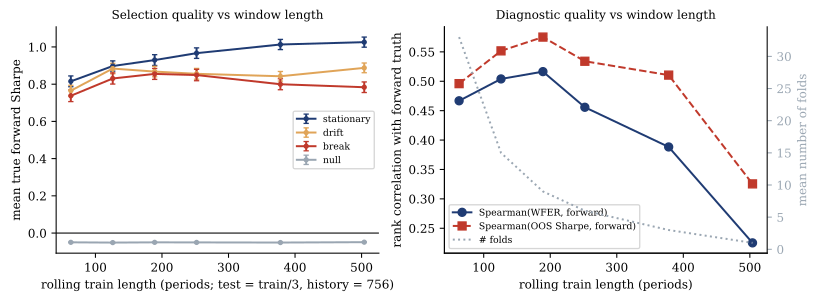
The sweep (Figure 4) separates two questions the folklore runs together: does window design change what you deploy, and does it change what you know about it?
Deployment is forgiving.
Mean deployed forward Sharpe is 0.567 at L_{\mathrm{train}} = 63 and then essentially flat from 126 up: 0.640, 0.651, 0.655, 0.651, 0.662 across \{126, 189, 252, 378, 504\}. Only a train window too short to estimate the surface (63 periods, one calendar quarter) measurably hurts. Beneath the flat aggregate there is mild regime texture that the folklore’s “shorter adapts faster” intuition only partly anticipates: stationary runs improve monotonically with train length (0.815 \to 1.026), break runs peak at 189 (0.855) and fade to 0.784 by 504, and drift runs are flat within noise (0.84–0.89) for L_{\mathrm{train}} \ge 126.
The estimate is not.
The diagnostic quality of the same folds moves a lot. The WFER–forward rank correlation rises from 0.467 (33 folds of a noisy-short window) to a peak of 0.516 at L_{\mathrm{train}} = 189 (nine folds), then collapses as folds disappear: 0.456 (six), 0.388 (three), and 0.225 at the single-fold corner—which is exactly the single train/test split that much practice still defaults to. The stitched OOS Sharpe traces the same arc (0.496 \to 0.575 \to 0.325) and dominates WFER at every train length. The RMSE of the stitched OOS Sharpe as an estimator of the forward Sharpe rises from {\approx}0.72–0.73 at many folds to 1.33 at one fold (the rise is essentially monotone, with a 0.003 dip between the two longest many-fold settings), while its bias stays below 0.02 in magnitude in every cell: fold-stitching buys variance reduction, not bias correction. The actionable summary: pick the train window long enough to learn the surface ({\ge}126 periods here), then cut the rest of the history into as many non-overlapping OOS segments as that allows—the deployment will not care, and every diagnostic will.
Procedure ranking: rolling deploys best; shuffled k-fold flatters most; CPCV-lite ranks best
| True forward Sharpe (deployed) | Validation estimate | |||||||
| Procedure | overall | station. | drift | break | bias | bias_{\text{drift}} | bias_{\text{break}} | \rho(est, fwd) |
| Single split | 0.558 | 1.030 | 0.702 | 0.551 | +0.073 | +0.212 | +0.103 | 0.477 |
| Anchored WFO | 0.624 | 1.062 | 0.790 | 0.692 | +0.048 | +0.149 | +0.071 | 0.524 |
| Rolling WFO | 0.657 | 0.962 | 0.869 | 0.846 | \mathbf{+0.013} | \mathbf{+0.060} | \mathbf{-0.034} | 0.529 |
| Shuffled k-fold | 0.623 | 1.066 | 0.788 | 0.688 | +0.083 | +0.191 | +0.147 | 0.541 |
| CPCV-lite | 0.624 | 1.062 | 0.790 | 0.692 | +0.049 | +0.155 | +0.079 | 0.636 |
Table 3 ranks the procedures on both jobs a validation scheme performs: choosing what to deploy, and estimating how it will do.
Deployment.
Rolling WFO deploys best overall (0.657; mean regret against the forward-oracle 0.226), entirely through its advantage under drift and breaks; under stationarity it pays the recency price of Section 6.4. Anchored, CPCV-lite, and shuffled k-fold form a cluster near 0.623–0.624—unsurprisingly, since all three effectively deploy a full-history selection (k-fold’s CV-mean argmax lands almost exactly where the full-history argmax does). The single split is clearly worst (0.558; regret 0.325): it selects on only the first 65–75\% of the history, and under drift or break the discarded recent data is precisely the most relevant.
Estimates.
The shuffled k-fold is the most optimistic estimator overall (+0.083 Sharpe bias), and its failure is regime-specific in the way [12] and [7] would predict: essentially unbiased under stationarity (-0.006, consistent with the validity result of [6] for this serially independent DGP), but +0.191 under drift and +0.147 under break, because interleaved test folds let the procedure train on the future of the very points it tests. Notably, the single split’s estimate is even worse under drift (+0.212): one early-selected configuration, one late test window, and a forward horizon that keeps moving. Rolling is the least biased overall (+0.013), though this is partly cancellation (+0.060 drift, -0.034 break, +0.002 stationary). And a sobering regularity cuts across all five procedures: under drift every bias is positive—when the optimum moves, decay continues into the deployment horizon, so even a perfectly honest OOS estimate is a backcast, not a forecast.
Ranking quality.
As a ranking signal across runs, CPCV-lite’s estimate is the clear winner (\rho = 0.636 vs. 0.524–0.541 for everything else): averaging 15 combinatorial paths stabilizes the estimate even in a DGP with no label leakage to purge, supporting the multiple-paths argument for CPCV [12] on grounds independent of purging. The single split is the weakest ranker (0.477) as well as the weakest deployer—the worst of both worlds.
Discussion
If you run walk-forward, you already have something better than WFER.
The ratio’s numerator—stitched OOS performance—is where the information lives; its denominator adds selection-biased noise and a divide-by-near-zero failure mode. On every regime with an edge, the stitched OOS t-statistic and Sharpe dominate WFER on both ranking and loser-detection, at zero additional computational cost. The IS\toOOS rank correlation is a strong complement (best under stationarity and drift, and for anchored folds), because it uses the whole \theta-cross-section per fold instead of one selected point. If a ratio must be reported, it should be the per-period normalized form (norm), accompanied by a check that the IS denominator is statistically distinguishable from zero—a check that fails somewhere in most runs at conventional significance (Section 6.3).
Retire the grading table.
In its only coherent (normalized) reading, the folk grading gets one thing right—the ordering below 0.5—and both of its labels wrong: the “excellent” grade above 0.8 contains nothing the “acceptable” bin does not, and the “borderline/overfit” zone below 0.5 averages solidly positive forward performance in our world. The literal raw-PnL form cannot reach the thresholds at all, and the six runs that do reach them are dominated by degenerate denominators. The defensible uses of WFER are relative (ranking candidate configurations within a shop) and sign-based (a negative ratio is a genuine red flag: 56.5\% losers, half of them null-regime). Absolute grades imported from folklore transfer neither across window designs (raw vs. normalized differ by a factor of 3–4 here by construction) nor, on this evidence, across the 0.5 line where the bins stop separating.
Window folklore, repriced.
Anchored-vs.-rolling should be presented as a bet, not a best practice: rolling buys 0.08–0.15 of forward Sharpe under drift and breaks at a premium of 0.10 under stationarity. Window length is the reverse: it barely moves the deployment (above a minimum train length) but strongly moves how much the validation tells you, peaking near nine folds in our setting and collapsing at the single-split corner. The common default of one IS/OOS split is quantifiably the worst choice on both axes. And the k-fold warning for finance deserves its precise form: with serially independent returns the scheme’s estimate is fine under stationarity; what kills it is non-stationarity, where it trains on the future and overstates forward Sharpe by 0.15–0.19—while deploying essentially the same configuration as anchored WFO. The danger is the number it reports, not the parameter it picks.
Limitations
Our returns are Gaussian and serially independent given the surface, with a single constant-share market factor; real returns have fat tails, volatility clustering, and dependence that would degrade all diagnostics further and could re-order them—in particular, CPCV-lite’s embargo does no real work here because there is no label overlap to purge, so our CPCV result speaks to its multiple-paths averaging, not its purging. The strategy family is one-dimensional with a single Gaussian bump; interacting parameters and multimodal surfaces (studied in a sibling paper on plateau heuristics) are out of scope. The selection rule is everywhere the argmax of train-window Sharpe; regularized or shape-aware selection would change both deployments and diagnostics. Our regimes are stylized (linear drift, single break, fixed 252-period forward horizon), the surface amplitude range (0.4–2.0 annualized Sharpe) is generous, and lower true edges would lower every correlation in Table 1. The bin-calibration findings also depend on the surface geometry: in worlds with optima far sharper than our sampled widths (0.10–0.35), the top WFER grade can begin to separate from the next one, so the “flat above 0.5” result should be read within the disclosed width range. The thresholds are evaluated as bins over a heterogeneous design mix, not as decision policies with explicit costs; and our normalized WFER is one disclosed reading of “annualized OOS over annualized IS”—other normalizations (per-trade, risk-adjusted) circulate. Finally, we model no transaction costs and no re-optimization during the forward horizon, which a live walk-forward deployment would perform.
Conclusion
We gave walk-forward validation’s acceptance statistic its first controlled test against a known ground truth. The walk-forward efficiency ratio is informative but strictly redundant: every job it does is done better by the stitched OOS t-statistic, OOS Sharpe, or IS\toOOS rank correlation computed from the same folds, and its distinguishing operation—dividing by in-sample PnL—contributes noise, a degenerate-denominator failure mode affecting one run in five (and half of the no-edge runs), and a units problem that makes the popular thresholds unreachable in their literal raw-PnL form (6 of 8{,}000 runs). The folk grading is miscalibrated even in its coherent normalized reading: nothing separates “excellent” from “acceptable,” and the “overfit” zone averages +0.59 to +0.83 forward Sharpe. The window folklore fares better: rolling windows do beat anchored under drift and breaks (and cost 0.10 under stationarity), window length matters chiefly through the number of folds and hence the quality of the estimate, and walk-forward’s forward-chained structure does discipline the estimate relative to a shuffled k-fold—whose optimism under non-stationarity we quantify at +0.15 to +0.19 Sharpe. Validate with walk-forward, by all means; read its OOS track record directly, guard every denominator, and leave the 0.8/0.5/0.3 table behind.
Reproducibility.
All experiments are deterministic given the released seeds (101 for the main batch, 303 for the window sweep). A single command
(python scripts/run_all.py) regenerates every result,
python -m wfo_experiments.figures regenerates every figure,
and scripts/check_paper_numbers.py verifies that every
number quoted in this paper matches the generated results to rounding.
The generative model, the five procedures, the diagnostics, and the
analysis are provided as an open-source package.
References
The literal raw-PnL WFER recipe and the 0.8/0.5/0.3 grading table tested in this paper appear in the author’s own earlier practitioner writing (a market-making blog post on walk-forward optimization). This paper is therefore a controlled self-audit of advice the author has himself circulated, not an attack on a third party. The thresholds have no citable primary source that we could locate; the only stable documented artifact is TradeStation’s WFE \ge 50\% pass criterion [19], and we deliberately do not attribute the triple to [14].↩︎